

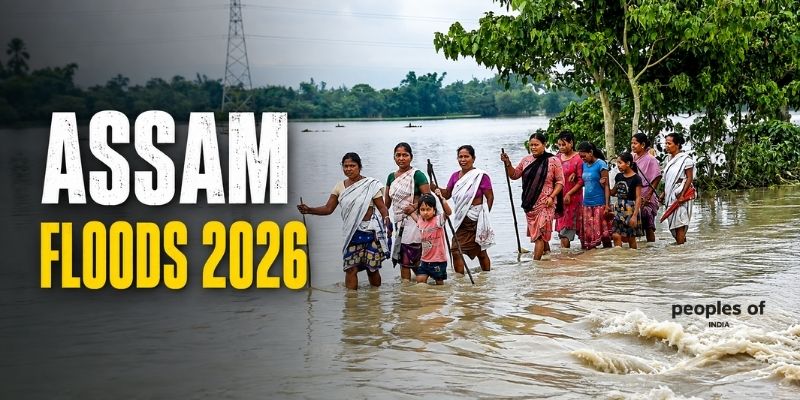
The 2026 Assam flood is one of the state’s worst disasters in years. As of 10 August 2026, it has claimed 101 lives, affected over 1.68 lakh people, and submerged 481 villages across 15 districts. Homes, farmland, roads, schools, and hospitals have all taken a hit, and floodwaters are only now beginning to recede in parts of the state.
This isn’t just one river overflowing. Heavy monsoon rain over Assam and upstream catchments pushed the Brahmaputra, Barak, and their tributaries past danger levels. Water broke through embankments in several places, swallowing villages, farms, and roads. The state government has clarified the surge came from upstream rainfall, not a dam release from Bhutan.
Assam floods almost every year. But experts say climate change, riverbank erosion, unplanned urban growth, and vanishing wetlands are making each flood worse than the last. This report looks at what’s happening on the ground, why it keeps happening, and what could actually change the outcome next year.
Key Takeaways
- The 2026 Assam floods claimed 100 lives and affected more than 1.68 lakh people across 15 districts, with 481 villages still submerged as of 10 August.
- The disaster was driven by heavy monsoon rainfall over Assam and upstream catchments, not by a Bhutan dam release, a claim the state government has officially denied.
- Sivasagar, Charaideo, Dibrugarh, Jorhat, and Golaghat were among the worst-hit districts, with over 4,600 houses fully destroyed and 15,000+ partially damaged.
- Relief efforts brought together the Army, NDRF, SDRF, Assam Police, and volunteers, with the Air Force alone rescuing 458 people and dropping over 9 tonnes of supplies.
- The Centre released ₹379.35 crore in SDRF funds for Assam, part of a larger ₹2,117.85 crore package for seven flood-hit states.
- Corporate and public support included a ₹7 crore donation from Vedanta Group, a ₹12 crore BJP relief campaign, and diaspora fundraising through AFNA.
- Nearly 75,000 families are receiving direct cash transfers, and Assam has rolled out digital, geo-tagged damage assessments to speed up compensation.
- Compared to 2020 and 2022, when 30+ districts and millions of people were affected, the 2026 flood is severe but smaller in overall scale.
- Long-term fixes need more than embankments, better forecasting, wetland protection, flood-resilient infrastructure, and stronger land-use planning are all part of the picture.
Understanding Assam Before Understanding the Flood
Assam lies in north-eastern India and has two major river valleys: the Brahmaputra Valley and the Barak Valley.
The state is surrounded by hills and mountains:
- Arunachal Pradesh to the north and northeast
- Bhutan to the northwest
- Nagaland and Manipur to the east
- Meghalaya and Mizoram to the south
What was the situation and recovery status of Assam floods as of 10 August 2026?
During July persistent rainfall over Assam Arunachal Pradesh Meghalaya and the Bhutan catchments greatly increased river discharge with the Brahmaputra and many tributaries crossing danger levels.
| Flood Event Metric | 2020 Flood Season | July 2026 Wave | August 2026 Wave |
|---|---|---|---|
| Total Human Casualties | 149 deaths | 47 deaths | 100 deaths |
| Affected Districts | 30 out of 33 districts | 11 districts | 15 districts |
| Population Affected | Over 5,000,000 | Over 653,000 | Over 168,000 |
| Affected Villages | 5,474 villages | 939 villages | 481 villages |
| Submerged Cropland | Over 150,000 hectares | Over 24,200 hectares | Over 14,380 hectares |
| Operational Relief Camps | Over 150 camps | 273 camps and centers | 133 camps and centers |
Exceptionally intense rainfall caused sudden flooding in some districts, submerging roads and disrupting communication. Floodwaters expanded into agricultural fields, towns, forests and protected areas while government agencies established relief camps and deployed rescue teams with the Army, NDRF, SDRF police, and local volunteers assisting affected communities.
Was This the Worst Flood in Assam’s History?
| Year | Significance |
|---|---|
| 1950 | Massive Assam earthquake altered the Brahmaputra’s course and increased sedimentation, worsening future flood risk. |
| 1988 | One of the state’s major flood years. |
| 1998 | Severe statewide flooding. |
| 2004 | Large-scale flood damage across many districts. |
| 2012 | Major floods affecting millions. |
| 2017 | Significant monsoon flooding. |
| 2019 | Over 5 million people affected in Assam. |
| 2020 | Around 5 million affected; 149 total fatalities, including landslides. |
| 2022 | Among the worst floods of the decade, affecting around 5.6 million people across 32 districts. |
| 2026 | Serious flooding with widespread impacts; final assessments are still ongoing. |
What is the scientific reason behind the Assam floods 2026?
Assam’s floods look simple on the surface, just heavy rain and rising rivers. But the 2026 disaster had several layers behind it, from geography and climate change to deforestation, erosion and even a false rumor about Bhutan’s dams. Here’s a quick breakdown.
| Topic | Explanation |
|---|---|
| Natural or human-made | The monsoon flood is natural. Deforestation, riverbank erosion, wetland loss and unplanned construction make it far more destructive. |
| Geography | Assam sits inside a river valley surrounded by mountains on three sides. It collects rainwater from Tibet, Bhutan, India and neighbouring regions. |
| Why the Brahmaputra is different | It carries a huge water volume, heavy sediment and shifting channels. Its braided pattern and fast Himalayan runoff make it one of the world’s most unpredictable rivers. |
| The 2026 monsoon | Assam and its upstream catchments saw repeated heavy rain, with some areas recording up to 490% above normal. River levels kept rising for days without a break. |
| Climate change’s role | Climate change did not directly cause this flood. It is making extreme rainfall more frequent and intense, which raises overall flood risk. |
| Bhutan dam rumor | False. The state government confirmed the river surge came from heavy upstream rainfall, not a dam release in Bhutan. |
| Deforestation | Cleared forests can no longer absorb rainwater as before. This increases runoff, speeds up erosion and raises flood peaks. |
| Riverbank erosion | The Brahmaputra constantly wears away its banks, destroying homes, farmland and roads even outside the flood season. |
| Vanishing wetlands | Assam has lost many of its beels, or natural wetlands. Less natural storage means more pressure on rivers and nearby settlements. |
| Guwahati’s urban flooding | Poor drainage, wetland encroachment and concrete surfaces flood the city on their own, even when the Brahmaputra is nowhere near its peak. |
| Assam vs Uttarakhand | Assam floods slowly across wide, flat plains. Uttarakhand floods fast through steep mountain valleys. Different terrain, different disaster. |
Together, these factors show that no single event caused the flood. It came from heavy monsoon rain meeting a landscape that has grown more vulnerable over the years, and that distinction matters for finding real solutions.
What is the latest death toll and damage count in the Assam flood?
When people hear about floods, they often focus on water levels and rainfall. However, the real tragedy lies in the lives the flood disrupted.
| Indicator | Official Status (As of 10 August 2026) |
|---|---|
| Flood-related deaths | 101 |
| Districts still affected | 15 |
| People affected | More than 1.68 lakh |
| Villages still submerged | 481 |
How did the Assam floods affect life?
How did the Assam floods affect people, infrastructure, education, agriculture, and daily life? The 2026 monsoon floods heavily affected families, damaged infrastructure, disrupted education, harmed agriculture, and affected local businesses and daily life across Assam. Here are the key questions and answers about the Assam flood 2026:
1. Which districts are most affected by the Assam floods 2026?
- Sivasagar, Charaideo, Dibrugarh, Dhemaji, Lakhimpur, Golaghat, Jorhat, Tinsukia, Majuli, Darrang, Sonitpur, Biswanath, Kamrup, Kamrup Metropolitan, and other nearby districts depending on river levels and rainfall.
2. What was the Assam floods 2026 death toll and how many people are missing?
- The 2026 Assam monsoon floods have claimed 108 lives (as of date 10th Aug), while reports of missing people have varied, with several cases reported 1.68 lakh people affected during the peak flood period.
3. How many relief camps are set up for Assam flood victims in 2026?
- The flood situation changed during the 2026 monsoon. ASDMA reported 487 relief camps in July, which dropped to 31 by mid-August with over 5,000 inmates as waters receded.
4. How many houses were damaged or destroyed in the Assam floods 2026?
- 4,657 houses were fully destroyed and 15,232 were partially damaged across affected districts during the 2026 Assam monsoon floods.
5. How have the Assam floods 2026 affected schools and students?
- Over 80% of schools in upper districts were flooded. Floods damaged classrooms and learning materials, while the government provided ₹2–3 lakh per school for repairs and distributed textbooks and uniforms to over 1.5 lakh students.
6. What are the health risks and diseases after the Assam floods 2026?
- Health concerns included waterborne diseases such as diarrhoea, dysentery, cholera, and typhoid; vector-borne diseases such as dengue, malaria, and Japanese encephalitis; as well as skin infections, fungal issues, and snake bites. The government deployed medical teams with ORS, medicines, and chlorine tablets.
7. How much crop area was damaged in the Assam floods 2026?
- Agriculture suffered as floods submerged over 24,000 hectares of paddy, vegetables, tea gardens, and fisheries. Livestock losses included cattle, goats, and poultry, while overflowing fish ponds caused aquaculture losses.
8. Which roads and bridges were damaged in the Assam floods 2026?
- Severe infrastructure damage affected multiple districts. River erosion and floodwaters damaged over 8.3 kilometres of national highways and destroyed key crossings, including the Kemi River bridge, Simen River railway bridge, and Pagla River bridge.
9. Are train services affected by the Assam floods 2026?
- Yes. Severe floods disrupted train services by submerging tracks and station yards. While mainline connectivity between Guwahati and Dibrugarh has resumed using diesel locomotives for safety, some regional routes still face cancellations and diversions.
10. Are flights affected by the Assam floods 2026?
- No. Commercial flights to and from Assam are operating normally without major flood disruptions. Passenger schedules remain stable at Guwahati’s airport, while airlines are providing cargo transport for relief supplies.
11. How have the Assam floods 2026 affected electricity and mobile networks?
- Severe floods knocked out power to over 82,000 households and triggered emergency cross-network mobile roaming. Nearly 13,000 families faced ongoing outages weeks later, prompting the government to waive up to 300 units of electricity for affected residents.
12. Is drinking water contaminated in Assam flood-affected areas?
- Severe floodwaters contaminated local wells, hand pumps, and water supplies, increasing disease risks. Authorities distributed packaged drinking water, chlorination tablets, and water purification support across relief camps.
13. What is the total economic loss from the Assam floods 2026?
- The 2026 Assam floods resulted in an estimated cumulative economic loss of ₹15,000 to ₹30,000 crore, impacting over 7 lakh people and claiming 85 to 100 lives. With 45,000 hectares of cropland and 494 Anganwadi centres destroyed, authorities provided ₹1,000 crore in immediate relief, including ₹75,000 cash transfers per affected household.
14. How are Assam flood survivors coping with mental health issues?
- Floods can trigger anxiety, trauma, and depression among survivors. While communities rely on informal support, professional mental healthcare remains scarce, leaving emotional recovery largely neglected compared with physical reconstruction.
Emergency money and supplies gave quick help to families, but full recovery will take more time. Work is still underway to fix broken roads and bridges, help people get back to work, and rebuild affected towns and villages.
Assam Flood Government Response 2026
PM Modi, compensation, the Kaziranga wildlife crisis, and relief operations were among the key issues surrounding the Assam floods.
Rescue, Relief and Recovery
The section below covers how disaster response unfolded during the Assam floods 2026 from government agencies like ASDMA, NDRF, SDRF, Army, and police, to financial assistance, wildlife impact at Kaziranga, and support from NGOs, religious groups, and international organizations, framed as commonly searched questions.
| Query | Response |
|---|---|
| How did the Assam government respond to the 2026 floods? | The 2026 Assam flood response involved Assam Government, district administrations, ASDMA, SDRF, NDRF, Indian Army, Air Force, Ministry of Home Affairs, Central Government, local police, health departments, and volunteers coordinating across multiple districts. |
| What was the first emergency response to the Assam floods 2026? | District administrations issued flood alerts, evacuation warnings, boat deployment orders, school closures, embankment monitoring, and relief camp identification. Rescue teams used inflatable boats, motorboats, country boats, and high-clearance vehicles, prioritizing children, pregnant women, elderly, disabled persons, and patients. |
| What role did ASDMA play in the Assam floods 2026? | ASDMA led flood response, coordinated with Army, IAF, SDRF, NDRF, and district teams, managed relief camps, distributed food and hygiene kits in worst-hit areas like Sivasagar and Jorhat, issued daily river bulletins, and mobilized aid from organizations. |
| How many people did NDRF rescue in the Assam floods 2026? | NDRF is India’s specialized rescue force under the Home Ministry. During the Assam floods, NDRF teams used boats to evacuate stranded people, handled medical emergencies, and delivered supplies to cut-off areas with Central Government support. |
| What did the SDRF do during the Assam floods 2026? | SDRF joined NDRF, Army, and district authorities in flood-hit Assam. They carried out evacuations in Sivasagar, Jorhat, and Golaghat, delivered supplies and healthcare to isolated villages, and surveyed destruction of homes, crops, and animals. |
| How did the Indian Army help during the Assam floods 2026? | The Army’s Operation Jal Rahat saved over 1,000 people in Sivasagar, Jorhat, and Charaideo. They used boats and drones to drop 19 tons of food, set up medical camps, and treated both people and livestock. |
| Did the Indian Air Force assist in the Assam floods 2026? | The IAF supported Assam flood efforts with helicopters despite poor weather. They saved 458 trapped individuals, dropped more than 9 tonnes of rations and medical supplies, and concentrated on Sivasagar and nearby areas with broken road links. |
| What role did Assam Police play in the Assam floods 2026? | Assam Police went beyond regular duties during floods, evacuating families, managing crowds, securing relief camps, diverting traffic, searching for missing people, and coordinating rescues, all while many stations operated underwater themselves. |
| What medical response was deployed during the Assam floods 2026? | The health department deployed over 200 doctors, ran 3,103 camps, and treated 206,000+ people for skin infections and waterborne diseases in Sivasagar, Jorhat, and Golaghat, with mobile teams and military medics supporting. |
| How many relief camps were set up during the Assam floods 2026? | Assam’s health department deployed over 200 doctors across flood hit districts like Sivasagar, Jorhat and Golaghat, treating over 2.06 lakh people at 3,103 free camps. A 50 member mobile team, medical colleges, ESIC, AMU volunteers and Army medics all joined the relief effort. |
| How much central government funding was released for the Assam floods 2026? | On 1 August 2026, Amit Shah approved ₹2,117.85 crore in SDRF funds for seven flood hit states. Assam got ₹379.35 crore, Gujarat, Maharashtra and Odisha ₹500 crore each, Himachal Pradesh ₹193.95 crore, and Arunachal Pradesh ₹44.55 crore. NDRF teams were pre deployed, Defence Ministry gave logistics support, and two Central teams assessed Assam’s damage. |
| What relief announcements did CM Himanta Biswa Sarma make for Assam flood victims? | CM Himanta Biswa Sarma visited flood hit districts, announcing ₹9 lakh total ex gratia for deceased victims’ families, ₹15,000 interim relief for over one lakh affected households, and assured compensation for damaged houses after formal assessment. |
| What did PM Modi say about the Assam floods 2026? | PM Modi reviewed the Assam flood situation with state MPs, expressing solidarity and assuring continued Central support for rescue, relief, rehabilitation and financial aid. The Home Ministry echoed this through advanced SDRF releases, NDRF deployment and logistical support. |
| How did the Assam floods 2026 affect Kaziranga National Park? | Kaziranga spans 1,090 sq km and holds 2,613 rhinos, two thirds of the world’s population, plus over 1,200 elephants and 100+ tigers. Seasonal floods recharge its grasslands but turn deadly when water rises fast or NH715 blocks migration. In 2017, over 350 animals died, including 24 rhinos. |
| How many animals were rescued during the Assam floods 2026? | Over 10 lakh livestock were affected across Assam, with hundreds of wild animals swept away and many still stranded or missing. The Forest Department led rescue efforts, backed by the Vantara Foundation’s specialized teams and ambulance fleet, along with local NGOs and animal welfare groups. |
| Why do animals migrate out of Kaziranga during floods? | Kaziranga’s animals aren’t fleeing in panic, they’re following an ancient survival instinct, moving to higher ground like the Karbi Anglong Hills or the park’s 144 artificial highlands. This migration has happened for centuries. What’s changed is the risk, roads and traffic now turn deadly. |
| Which NGOs helped with Assam flood relief in 2026? | Multiple NGOs aided flood relief. Aahwahan Foundation, AFNA, Reliance Foundation, Smile Foundation, Feeding India, Bal Raksha Bharat, Khalsa Aid, Sachkhand Foundation, Ashray Foundation, Cellecor Foundation and MeghaShrey NGO provided food, medical aid, WASH support, child protection and hygiene kits across Jorhat, Sivasagar and Charaideo. |
| Which companies donated to Assam flood relief 2026? | Aahwahan Foundation, AFNA, Reliance Foundation, Smile Foundation, Feeding India, Bal Raksha Bharat, Khalsa Aid, Sachkhand Foundation, Ashray Foundation, Cellecor Foundation and MeghaShrey NGO provided food, medical aid, WASH support, child protection and hygiene kits across Jorhat, Sivasagar and Charaideo. |
| How did religious organizations help Assam flood victims in 2026? | Religious groups stepped up too. Caritas India, Believers Eastern Church, Global Sikhs and Purvanchal Bhikkhu Sangha distributed food, clean water, hygiene kits and financial aid to displaced families, showing faiths uniting for flood victims. |
| Did Assam receive international help for the 2026 floods? | Assam’s flood response stayed government led, with no major UN emergency appeal. Overseas Assamese diaspora groups like AFNA played a bigger role, channeling donations directly to local relief partners. |
These questions reflect how readers typically search for flood-response updates rescue numbers, relief funding, official announcements, and wildlife safety. Since figures like rescue counts and fund releases change frequently, keep answers dated and verify against the latest official bulletins before publishing.
What are the major floods in Assam’s history?
The table below summarizes some of the most significant flood years.
| Year | Key Facts |
|---|---|
| 1950 | The earthquake altered the Brahmaputra’s sediment regime, increasing long-term flood and erosion risk. |
| 1988 | One of the most severe floods of the late 20th century. |
| 1998 | Widespread flooding across Assam. |
| 2004 | Heavy monsoon flooding and extensive crop damage. |
| 2012 | Around 6 million people were affected; 124 deaths; 540 animals died in Kaziranga, including 16 rhinos. |
| 2015 | About 16.5 lakh people are affected across 21 districts. |
| 2016 | Around 18 lakh people were affected. |
| 2017 | About 4 lakh people were affected in Assam as part of wider Northeast floods. |
| 2019 | More than 52 lakh people were affected; 59 deaths; severe impact on Kaziranga wildlife. |
| 2020 | More than 50 lakh people were affected; 149 fatalities (including landslide deaths); 30 of 33 districts affected. |
| 2022 | One of the largest recent disasters; millions affected in Assam during widespread Northeast flooding. |
| 2026 | Serious flood concentrated largely in Upper Assam, with 97 reported deaths by early August and over 1.68 lakh people still affected as waters receded. |
Assam and Uttarakhand both face floods, but their land and weather are different. Assam often faces widespread flooding when rivers overflow, while Uttarakhand can face sudden floods and landslides in hilly areas. The table below compares how floods affect both states, their main causes, and the damage they can cause to people and infrastructure.
| Assam | Uttarakhand |
|---|---|
| Wide river plains | Narrow Himalayan valleys |
| Slow-moving floodwater | Fast-moving flash floods |
| Flooding lasts days or weeks | Flooding may last hours but is highly destructive |
| Riverbank erosion is common | Landslides dominate |
| Large-scale inundation | Valley destruction and debris flow |
| Millions affected over broad areas | Smaller affected area but higher local destruction |
Assam floods spread slowly over wide areas and affect more people. Uttarakhand floods hit fast and cause severe but more localized damage.
What are the common myths and facts about the Assam floods 2026?
Assam floods often lead to rumours and confusion. Here are some common myths about the floods, along with simple facts to understand what is really happening.
Myth 1
“Bhutan released water and caused the flood.”
Fact: The Assam Government stated that heavy monsoon rainfall and rising river discharge primarily caused the flood, not sudden water releases from Bhutanese dams.
Myth 2
“Building more embankments cannot stop floods completely.”
Fact: Experts agree that embankments reduce risk in many places but cannot eliminate flooding in a river system as dynamic as the Brahmaputra. Floodplain management, forecasting, wetland conservation, and resilient infrastructure are also essential.
Myth 3
“Kaziranga floods are always a disaster for wildlife.”
Fact: Seasonal flooding is a natural ecological process for Kaziranga. It renews grasslands and wetlands. Floods become dangerous when they rise unusually fast or deep, or when roads and human activity block animal migration routes.
What needs to change in Assam to prevent floods like this in the future?
Experts consistently recommend a combination of engineering, environmental, and policy measures:
River Mana
ent
- Continuous river monitoring.
- Sediment management.
- Stronger erosion control in vulnerable stretches.
Forecasting
- Better integration of rainfall and river-level models.
- Faster public warning systems.
- Village-level alerts.
Land Use
- Restrict construction in high-risk floodplains.
- Protect wetlands.
- Reduce encroachment.
Infrastructure
- Raise critical roads above expected flood levels.
- Flood-resilient schools and health centres.
- Elevated community shelters.
Climate Adaptation
- Climate-resilient agriculture.
- Improved drainage.
- Restoration of natural flood buffers.
These measures aim to reduce losses rather than attempt the impossible task of preventing all floods.
How Does Assam Compare With Previous Flood Years?
The table below summarizes the scale of major Assam floods using verified historical information.
| Year | Estimated People Affected | Deaths | Major Notes |
|---|---|---|---|
| 2012 | Around 60 lakh | 124 | Severe state-wide flooding; major wildlife losses in Kaziranga. |
| 2015 | Around 16.5 lakh | 42 | Floods across 21 districts. |
| 2016 | Around 18 lakh | 28 (early official count) | Tea gardens, agriculture, and Kaziranga heavily affected. |
| 2019 | More than 52 lakh | 59 | One of the largest floods of the decade. |
| 2020 | More than 50 lakh | 149 | Floods during the COVID-19 pandemic; 30 of 33 districts affected. |
| 2022 | Around 56 lakh (multiple reports) | More than 190 | One of the worst floods in recent history. |
| 2026 | More than 1.68 lakh still affected in latest phase | 97 | Severe Upper Assam flooding; recovery underway. |
2026 Assam Flood Recovery, Relief Funding, and Key Lessons
Assam Flood Recovery and Relief
The 2026 floods brought immense hardship, yet the response from the government, organizations, and global community reflects our shared resilience. This table summarizes the critical verified figures of this ongoing recovery effort.
| Category | Verified Figure |
|---|---|
| Flood-related deaths | 97 |
| People affected | More than 1.68 lakh |
| Districts affected (latest phase) | 15 |
| Villages submerged | 481 |
| Central SDRF support for Assam | ₹379.35 crore |
| Advance SDRF support to flood-hit states | ₹2,117.85 crore |
| Vedanta Group donation | ₹7 crore |
| BJP relief campaign | ₹12 crore |
| DBT beneficiaries (Phase 1) | About 75,000 families |
| AFNA fundraising | US $58,515 (as of 4 Aug 2026) |
While these figures highlight the severity of the damage, they also underscore the robust support system mobilized. We stand with the affected communities as they continue to rebuild and move forward together.
As Assam moved from emergency rescue into the recovery phase, the focus shifted to rebuilding, transparent relief funding, and faster compensation through technology. The table below answers common questions about recovery efforts, donations, and lessons for the future.
| Initiative | Details |
|---|---|
| What is the current phase of Assam’s flood recovery in 2026? | As floodwaters receded in August 2026, the government shifted focus from rescue to recovery and rebuilding. Assam introduced a digital damage assessment programme, and the Chief Minister launched digital survey training for officials in Sivasagar, Charaideo, Jorhat, and Golaghat. |
| How is technology changing disaster management in Assam? | Officials are being trained to collect geo-tagged data, digitally map damaged houses, record infrastructure losses, verify beneficiaries electronically, and reduce fraud. This digital approach will speed up compensation and improve transparency in disaster response. |
| How is the government repairing schools and infrastructure after the floods? | The Assam Government announced detailed surveys to identify damaged schools, with repairs prioritized before reopening. The digital damage assessment programme supports infrastructure restoration, as many schools had served as relief camps. |
| Which companies donated the most for Assam flood relief? | Vedanta Group donated ₹7 crore towards flood relief and rehabilitation in Assam. Chief Minister Himanta Biswa Sarma publicly thanked Chairman Anil Agarwal, calling it one of the largest publicly disclosed corporate donations during the 2026 floods. |
| What relief campaigns did political parties launch for Assam floods? | The Bharatiya Janata Party (BJP) launched a ₹12 crore relief campaign to provide clothing and essential assistance to affected families during the peak of the disaster, separate from official government disaster funding. |
| What did PM Modi say about the Assam floods 2026? | PM Narendra Modi reviewed the flood situation multiple times and spoke with Union Minister Sarbananda Sonowal. He assured full Central Government support for rescue, relief, and rehabilitation until Assam’s recovery was complete. |
| Which central ministers visited flood-hit areas in Assam? | Union Health Minister J. P. Nadda visited flood-hit Nepali Khuti village in Sivasagar. He met affected families, reviewed relief operations and health measures, and assured continued Central Government support for rehabilitation. |
| What is the direct cash transfer programme for Assam flood victims? | About 75,000 flood-affected families across four districts became eligible for direct cash assistance via Direct Benefit Transfer (DBT), sent straight to bank accounts. This aimed to reduce delays and improve relief transparency. |
| How much did the Assam Foundation of North America raise for flood relief? | As of 4 August 2026, AFNA’s campaign had 434 donors and raised US$58,515 total, including US$10,600 from 113 donors in just four days, funding food, hygiene kits, and household essentials. |
| What lessons can other states learn from the Assam floods? | Key lessons include earlier flood warnings, faster digital damage assessment, valuing community response since locals often save lives first, protecting wetlands, and designing infrastructure for more frequent extreme rainfall events. |
Together, these updates show a recovery process driven by digital transparency, strong government and community support, and generous contributions from corporates, political groups, and the global Assamese diaspora, offering a model other flood-prone states can learn from.
What Comes Next
Ninety-seven lives. Over 1.68 lakh people affected. Four hundred and eighty-one villages still under water as of early August. These are not just numbers in a table, they are the shape of what Assam has just been through, and what it is still working through.
The response has been real. The Army, NDRF, SDRF, and Assam Police moved fast, the Centre released over ₹379 crore for Assam alone, and nearly 75,000 families have already started receiving direct cash support. Vedanta’s ₹7 crore donation, the BJP’s ₹12 crore relief drive, and AFNA’s diaspora-led fundraising show that help came from every direction, not just from government offices.
But recovery is not a single event, it is a season that stretches long after the water goes down. Damaged schools need rebuilding before the next term starts. Roads and bridges like the ones lost on the Kemi and Pagla rivers need real repair, not patchwork. Families waiting on house compensation need that promise kept. And the mental toll on survivors, quieter than any flood number, deserves as much attention as the physical damage.
Assam floods almost every year. That will not change overnight. The state can improve its preparedness, reach isolated villages faster, and carry the lessons from 2026 into 2027.